IOL Core4 – The embedded IO-Link-compatible master module for up to 4 devices
An IO-Link®1 compatible master module for integration into your own hardware – testable with a Raspberry Pi, ready for series production.
IOL Core4 verbindet bis zu vier IO-Link-Sensoren und Aktoren (SDCI nach IEC 61131-9) mit Ihrem System. Das Modul ist für die Integration in eigene Elektronik konzipiert . Zur Evaluierung steht ein Kit aus Raspberry Pi, Carrier Board und IOL Core4 bereit, mit dem sich erste Prototypen ohne eigenes PCB-Design realisieren lassen.
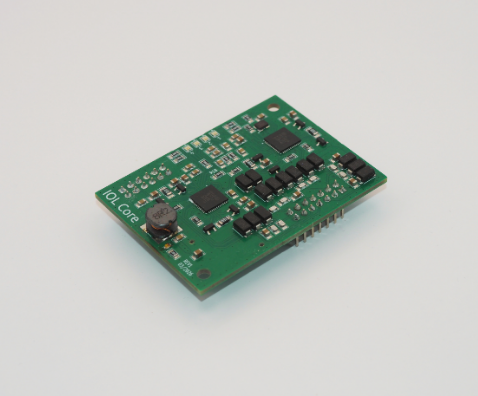
Product Overview
IOL Core4 is a compact master module with four IO-Link-compatible master ports. IOL Core4 provides IO-Link integration as a module that you can integrate into your own hardware.
Two versions are available:
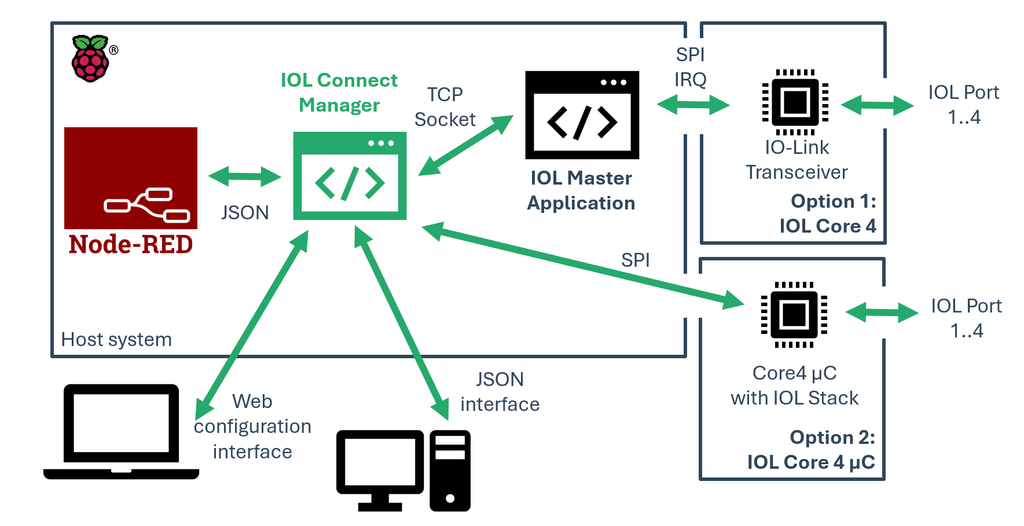
- IOL Core4: The IOL stack runs on your host system, such as a Raspberry Pi Compute Module.
- IOL Core4 Plus: Module with integrated microcontroller for the IOL stack. The host receives the data via an SPI command interface.
From Evaluation to Production
1. Evaluierung – Initial Prototypes Without a Custom Board
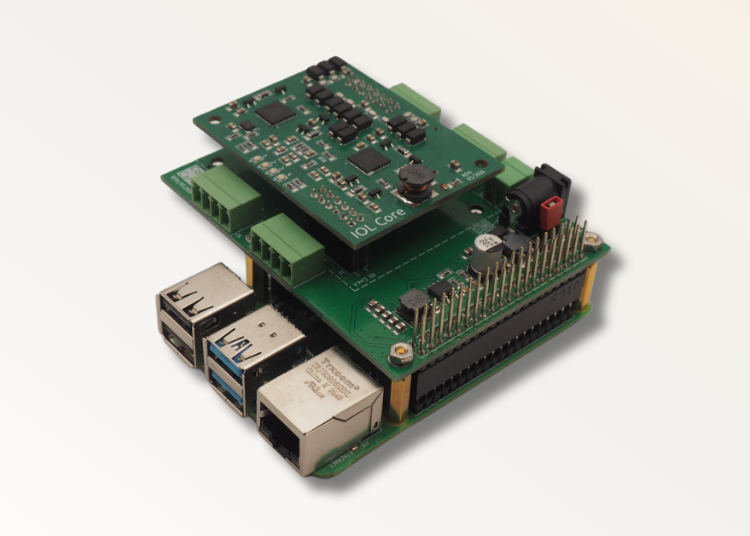
Using a Raspberry Pi, carrier board, and IOL Core4, you can test the IO-Link connection before developing your own hardware. This allows you to determine early on whether the solution is suitable for your specific application.
2. Development – Testing Software Integration
The IO-Link stack can be integrated in own software. The IOL Connect Manager software add-on, featuring ready-to-use IODD processing and Node-RED integration, supports the integration process.
3. Production Use – Choosing the Right Variant
Two variants are available for production use: The IO-Link stack runs either on the host system or directly on the IOL Core4 with its own microcontroller. Details on both variants can be found in the section “Comparison of the Two Variants.”
4. Scaling – Support for Implementation
Pinetek Networks provides support in selecting the right variant, integration, and customer-specific customizations, from small-batch production to large-scale orders.
Eval-Kit: Raspberry Pi + Carrier Board
The evaluation kit to get started with Raspberry Pi development consists of a carrier board, IOL Core4, a 24V power supply, and cables. With this kit, you can test the IO-Link connection without having to develop your own hardware.
Included in the kit:
- IOL Core4 module with 4 ports (PT-1204)
- Carrier board for Raspberry Pi with 40-pin GPIO interface. Power to the Raspberry Pi can be supplied through the Carrier Board
- 24V power supply
- 4 x 2-meter M12 cables with open ends
Technical Specifications (Kit):
| Supported Raspberry Pi Models | Raspberry Pi 4 and 5, operating systems Raspberry OS 12 (Trixie) and 13 (Bookworm) |
| Number of IOL Ports | 4 |
| Power Supply | 24 V screw terminal or round connector. The Raspberry Pi can optionally be powered via the carrier board (using a jumper). |
| Host Interface | 40 Pin GPIO |
Comparison of IOL Core4 Variants
| IOL Core4 | IOL Core4 Plus | |
|---|---|---|
| IO-Link stack runs on | Host system (e.g., Compute Module) | IOL Core 4 module (integrated microcontroller) |
| Prerequisites | Linux-compatible host system (e.g., CM4 or CM5) | Any host system with SPI Interface |
| Host interface | SPI, interrupt line | SPI (command interface) |
| Advantages | Full control over the host, lower module costs, easy integration | Reduces load on the host CPU, easier integration outside of Linux systems |
Add-on: IOL Connect Manager
The IOL Connect Manager is an add-on that extends your IO-Link integration beyond the basic functionality:
- IODD file management
- Seamless Node-RED integration
- A JSON API for accessing IO-Link devices
- A web interface for testing, parameterization, and SQLite database management
This professional solution, based on our proven Pinebox technology, significantly reduces setup time and eliminates manual configuration errors. The advanced features and efficient workflow of our software provide long-term value for your devices. Create a complete solution in no time with IOL Core4 and IOL Connect Manager using Node-RED!
Documentation, Software, and Support
- The manuals are available on the download portal: download.pinetek-networks.com/iol-core/doc
- The open-source software is available on GitHub: www.github.com/pinetek-networks/iol-hat
The online documentation can be found in the Knowledge Base:
Please use the Pinetek Networks Support Portal for extended support:
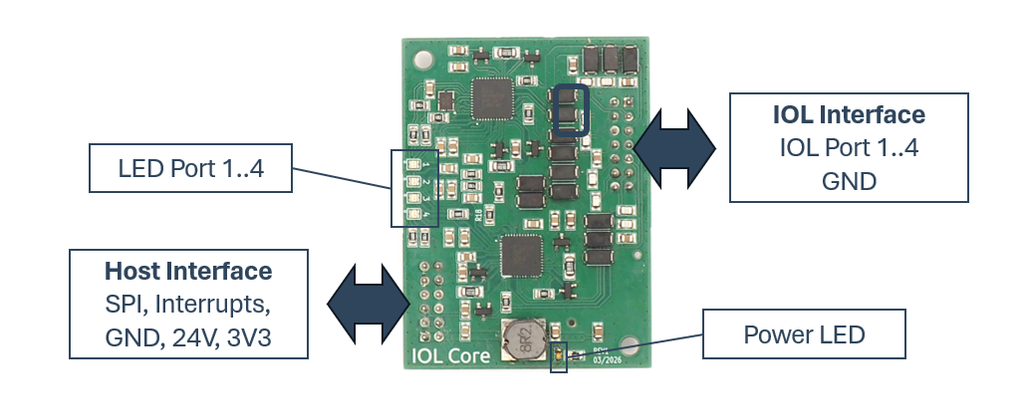
IOL Core4 / IOL Core4 Plus Connections
Technical Specifications for IOL Core4 / IOL Core4 Plus
Mechanical Specifications
| Dimensions 60 × 45 mm Height: 15 mm 2,54mm Host-Connectors |
| Mounting 14-pin/16-pin Host Connector Mounting holes for standoffs M3 |
| Temperature range -25 °- 60 °C |
Connections
| Power Supply 24V DC (+/-20 %), 3,3V Logikspannung Max. power consumption: – 24V: 2000mA for 4 IOL Ports – 3,3V: IOL Core4 (PT-1204) < 20mA, IOL Core4 Plus <75mA |
| 14-pin 2.54mm pin header IOL ports CQ, L+, DIA per port, common ground Class A (max. 500 mA per port) Speeds: COM1, COM2, COM3 (auto-detect) Operating modes: IOL, DI, DO 1 LED per port (red/green) |
| 12-pin 2.54 mm pin header (host) 24 V/3.3 V/GND SPI (MISO, MOSI, CLK) Port 1/2: SPI_CE0, Interrupt_1 (IOL Core 4 only) Port 3/4: SPI_CE1, Interrupt_2 (IOL Core 4 only) |
Communication
| LED Indicators Status per Port (red/green) 24V Status (Power) |
| API: TCP Socket (IOL Core4) or SPI (IOL Core4 Plus) API with binary protocol Commands: Port Power (on/off) Read+Write Process Data Read Parameter Data Write Parameter Data Get Port Info LED Control |
FAQ
What is the difference between the IOL Core4 and the IOL HAT?
The IOL Core4/IOL Core4 Plus is a module for Linux-based embedded devices, such as the CM4 or CM5. It has 4 master ports (the IOL HAT series has two ports per module). The IOL Core4 and the IOL HAT use the same software (IOL Master Application) on the Linux side. The IOL HAT is ideal for small production runs or one-off builds, while the IOL Core4 is designed for embedded designs in larger quantities using the customer’s own hardware.
Which IOL Core option is right for my project?
Both versions can be integrated quickly and easily. IOL Core4 is more cost-effective because the stack runs on the host controller, but it only works with a real-time extension on the host (typically 2 reserved cores with priority). IOL Core4 Plus requires almost no processing time on the host and can run asynchronously without real-time requirements. Due to the microcontroller, the hardware is slightly more expensive than the IOL Core4 variant
- IO-Link is a registered trademark of PROFIBUS Nutzerorganisation e.V.: io-link.com/, profibus.com
IOL Core and IOL Core4 Plus are compatible with IO-Link devices. Certification on behalf of the customer is possible. IOL Core4 is not a certified IO-Link master. ↩︎